How a single employee at an online sustainable grocer tackled EPR in 3 states across nearly 1,000 own-brand SKUs
The Challenge: EPR spanned a thousand of Thrive Market’s own products, partner brands and shipping materials, EPR laws in the US were proliferating, and Leah M. already had a full time job
Thrive Market is an online market for healthy, sustainable products, with its own member-exclusive product lines alongside products from partner brands.
That model shaped its EPR compliance challenge. Thrive Market needed to collect packaging data for nearly 1,000 own-brand SKUs, products from dozens of suppliers, and the materials used to ship orders. The work also meant accounting for differences in material categories and reporting rules across states.
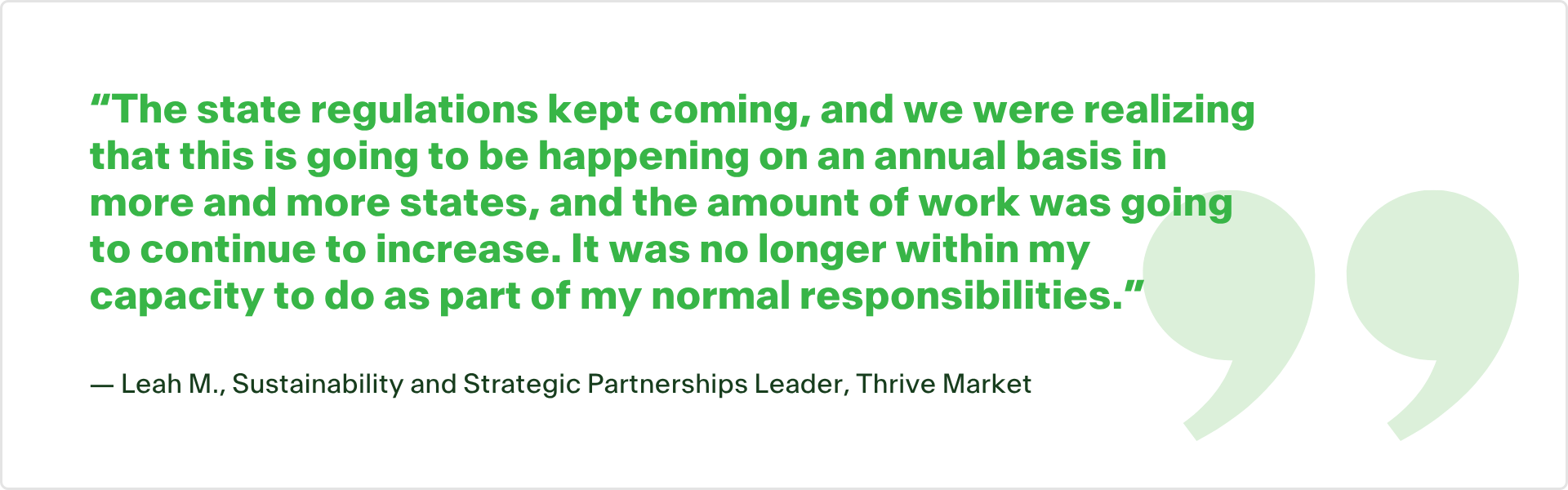
EPR reporting became part of Leah’s broader sustainability responsibilities. As EPR legislation in the US expanded from Colorado, to Oregon, to California and more state laws were pending, Leah realized that EPR compliance was becoming a very complex annual program that was beyond the capacity of a single person - especially one who already had a full time job - to manage. As Leah put it:
The Search for a Partner: Thrive Market wanted a responsive and expert EPR partner
As the workload grew, Thrive Market looked at outside providers. The team chose PCX for its expertise and willingness to work through the questions and numbers in detail.
The Implementation: PCX paired its software with hands-on support
PCX helped organize Thrive Market’s SKU and packaging information in its platform. Leah already had very well organized and comprehensive data, which made onboarding much easier. The PCX team worked directly with Leah to review and align the data categories for each state, answer questions, and help make the calculations more consistent. Leah valued the quick, thoughtful follow-up from the PCX team:
She also values the PCX’s platform’s multi-state tools and fee projections:
The Difference: Extra time to model and assess packaging changes to meet California source reduction requirements
The PCX platform freed Leah up to connect with internal teams to assess potential packaging changes to help meet California source reduction requirements.
Under California’s SB 54, the CAA must reduce plastic materials, measured by weight and number of components, by at least 10% by 2027, 20% by 2030, and 25% by 2032, compared with the 2023 baseline.
The Impact: Hundreds of hours and hundreds of thousands of dollars saved
Thrive Market filed EPR reports on time in multiple states. Leah estimated that PCX saved the team “maybe hundreds of hours” compared with its prior EPR reporting efforts. She expects future reporting cycles to get easier as Thrive can now build on the SKU and packaging information already in the PCX platform.
PCX’s review identified hundreds of thousands of dollars difference in projected fees. While reviewing the data for Thrive’s California fee estimate, PCX’s EPR experts correctly mapped packaging classifications and aligned sales data to correct reporting jurisdictions. Once the PCX team identified and adjusted these items, Thrive's EPR fee projections were reduced by hundreds of thousands of dollars.
PCX’s helped Thrive Market with its annual EPR budget. EPR fees across thousands of products in multiple states can add up to a significant cost for mid-sized companies, so having estimates in advance gives finance and sustainability teams helpful information they can use in annual planning and budgeting.
As Thrive Market explores packaging changes to support California’s source reduction goals, PCX’s software can model their potential impact on EPR fees, helping the team weigh costs and benefits before making changes to packaging.
Takeaways for grocers, food retailers, and online businesses with multiple suppliers
A large product range needs a reporting system that can keep up. PCX can help grocers and online retailers organize packaging data across own-brand products, supplier brands, and shipping materials.
EPR should not become one person’s second job. PCX’s packaging EPR software manages the recurring, state-specific reporting work, while EPR experts are there to guide the team and answer policy questions.
One dashboard beats a pile of spreadsheets. PCX’s packaging EPR platform can bring year-over-year reports and fee projections together, help teams spot packaging components to review, and model how packaging changes may affect EPR fees as companies work toward California source reduction requirements.
A solid baseline makes the next cycle easier. Once product and packaging information is organized, each new reporting year can build on the last, and teams can spend more time considering packaging choices and working with suppliers.
Model the cost of packaging changes. PCX’s EPR compliance software helps companies assess reduction options, compare their potential EPR fee impact, and plan for California’s source reduction requirements.
Managing EPR across a large online product range and dozens of suppliers and multiple states? Talk with PCX about organizing supplier data, managing state reporting, and assessing how packaging changes may affect EPR fees.
Book a call with our EPR Experts · Learn more about our Packaging EPR solutions