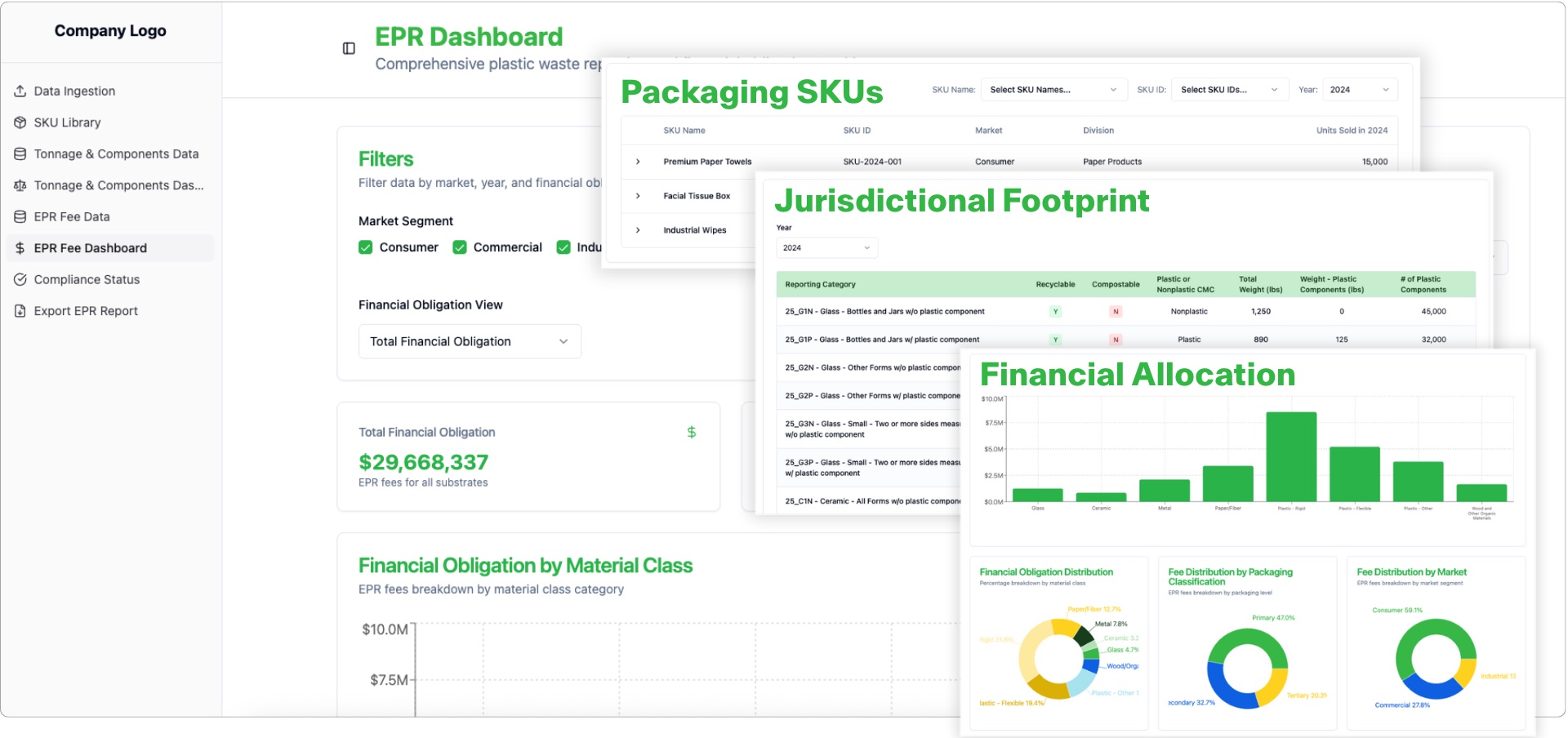
EPR compliance fees vary widely by region, material type, recyclability, and product volume.
Most programs calculate fees per kilogram or unit of packaging placed on the market, with costs determined by factors such as material composition, recyclability, and post-consumer recycled content.
In the United States, state programs like California’s SB54 are introducing eco-modulated fees, where producers pay less for recyclable or low-impact materials and more for difficult-to-recycle packaging.
Across the European Union, similar modulation models under the Packaging and Packaging Waste Directive reward brands that use circular materials and penalize high-waste designs.
For small producers, annual EPR costs may amount to a few thousand dollars; for large consumer brands selling across multiple markets, fees can reach hundreds of thousands per year.
Working with a compliance partner like PCX helps ensure accurate material classification, identifies potential exemptions, and minimizes overpayment through data-driven optimization.
Learn more about California’s EPR legislation in our California SB54 Guide. Also link to CAA
Can I manage EPR compliance and reporting in-house?
If you’re a small producer with a limited number of SKUs operating in a single EPR market, managing compliance internally can be feasible, especially if you have a dedicated resource and your reporting obligations are straightforward.
For companies selling many products across multiple states or countries, the process quickly becomes complex. It involves consolidating large volumes of packaging data, tracking evolving regulations, managing cross-functional workflows, and ensuring accuracy and alignment across jurisdictions.
Take our short quiz to see if managing EPR compliance in house is feasible.
How long does EPR compliance typically take?
The time required for EPR compliance depends on the complexity of your business, including the number of products, packaging formats, suppliers, and jurisdictions involved.
For a small producer with limited SKUs operating in a single state, registration and reporting might be completed in a few weeks. But for larger or rapidly growing brands managing hundreds of products across multiple EPR jurisdictions, the process can take months.
It’s important to note that EPR compliance is not a one-time project. Regulations evolve, reporting formats change, and new markets continue to adopt EPR frameworks. Maintaining compliance requires ongoing monitoring, data updates, and reporting cycles throughout the year.
What data do I need to collect for EPR reporting?
EPR reporting requires comprehensive packaging data, and the details vary by state or country. To ensure compliance, producers must track:
- Material types and quantities, including component-level details such as substrate, coating, and color.
- Packaging weights and recyclability, by format and material category (some states define more than 140 categories).
- Covered and exempt products, based on each jurisdiction’s scope.
- Sales or distribution data by state, to allocate packaging volumes correctly.
Collecting this information typically involves inputs from multiple internal teams as well as packaging suppliers and co-packers.
What are my options for EPR compliance?
Most companies choose one of three paths—each with clear trade-offs in cost, effort, and scalability.
- DIY
Pros: Lowest upfront cost; full control.
Cons: Months of internal work; higher risk of reporting errors; limited fee/source-reduction optimization; hard to keep up with fast-changing rules across regions. - Consultants
Pros: Expert guidance; tailored recommendations.
Cons: Expensive and project-based; no ongoing platform; limited scalability across jurisdictions; still requires heavy internal coordination. - Software Platforms
Pros: Automates multi-jurisdiction reporting; centralizes data; can include expert support; can enables fee optimization and source-reduction planning.
Cons: Quality and coverage vary - some tools are calculator/spreadsheet-centric, which can fall short on end-to-end compliance and global scale.
Bottom line: For brands managing many SKUs, suppliers, and markets, a dedicated platform with embedded EPR expertise usually offers the best balance of cost, efficiency, and ongoing compliance, especially when it delivers global rule updates, audit-ready reporting, and optimization features out of the box.
Can EPR fees be reduced?
Yes, often materially, if you optimize the right levers.
- Right-sized data
Capture only what regulations require—no more, no less—to avoid over-reporting and inflated fees. - Best-fit reporting pathway
Where available, choose simplified or small-producer tiers to lower administrative and fee burden. - Precise material coding
With 100+ categories in some schemes, accurate classification prevents paying higher rates than necessary. - Exemptions & carve-outs
Systematically identify eligible exclusions (by package type, volume, or channel) to reduce totals. - Design for eco-modulation
Light-weighting, recyclable formats, and removing problematic components can trigger lower fee bands. - Multi-market efficiency
Standardize data architecture and workflows across jurisdictions to eliminate duplication and scale with growth.
Still have questions? Book a consultation with our EPR specialists